





Assessing Vietnam's Labor Market in the First Half of 2026
03/08/2026
Vietnam's labor market demonstrated remarkable resilience during the first half of 2026, with sustained growth in employment, average income, and recruitment demand compared to the same period in 2025. Despite these positive developments, the market continues to face evolving challenges, including increasing demand for highly skilled talent, intensified competition among job seekers, and the ongoing structural transformation of the workforce driven by digitalization and economic restructuring.
A Resilient Labor Market Amid Persistent Challenges
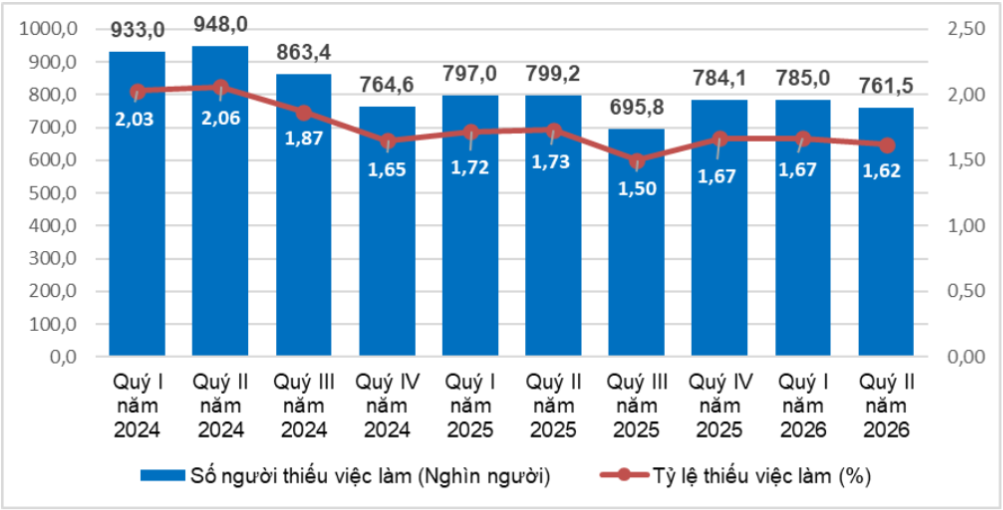
Vietnam's labor market demonstrated notable resilience during the first half of 2026, supported by the country's sustained economic recovery. Rising recruitment demand and stronger employment opportunities contributed to improvements in both job creation and workers' average income. According to the General Statistics Office (GSO), the labor force, employment rate, and average monthly earnings all increased compared with the same period in 2025. Meanwhile, the unemployment rate remained low at 2.22%, while the underemployment rate declined to 1.65%, indicating continued stabilization and gradual improvement in labor market conditions.
Key Highlights
- 53.7 million people participated in Vietnam's labor force.
- 52.6 million people were employed.
- Average monthly income reached VND 9 million, an increase of approximately VND 717,000 year-on-year.
- 29.7% of the workforce held formal educational qualifications or professional certifications.
- The proportion of informal employment declined to 61.9%, reflecting a gradual improvement in the quality and formalization of employment.
Key Recruitment Trends in 2026
1. Employers Are Prioritizing Quality Over Quantity in Hiring
As businesses increasingly focus on operational efficiency, recruitment strategies in 2026 are shifting from expanding headcount to attracting high-quality talent. Rather than hiring at scale, employers are placing greater emphasis on candidates who can deliver immediate value, adapt quickly to organizational culture, and contribute effectively from the outset.
Demand remains strong across industries such as Marketing, Sales, Information Technology (IT), Logistics, Manufacturing, and Supply Chain Management. Beyond academic qualifications, employers are placing greater importance on practical experience, technical expertise, adaptability, and digital proficiency, reflecting a broader shift toward competency-based recruitment.
2. Demand for Highly Skilled Talent Continues to Grow
The rapid advancement of artificial intelligence (AI), automation, and digital transformation is fundamentally reshaping workforce requirements. In addition to technical knowledge, employers increasingly seek candidates with strong digital literacy, analytical thinking, problem-solving capabilities, adaptability, and foreign language proficiency.
This trend is widening the skills gap between highly qualified professionals and lower-skilled workers, underscoring the need for continuous learning, upskilling, and professional development to remain competitive in an evolving labor market.
3. The Service Sector Continues to Drive Employment Growth
The service sector remained the largest source of employment in the first half of 2026, accounting for approximately 40.9% of total employment. It was followed by industry and construction (33.9%) and agriculture, forestry, and fisheries (25.2%).
This employment structure reflects Vietnam's ongoing economic transformation, with labor gradually shifting from traditional industries toward higher value-added sectors. The trend is closely aligned with the country's accelerating digital transformation, urbanization, and long-term economic development objectives.
Persistent Challenges Facing the Labor Market
Despite encouraging signs of recovery, Vietnam's labor market continues to face several structural challenges. One of the most pressing issues is the widening gap between employers' recruitment needs and the quality of the available workforce, making it increasingly difficult for businesses to find candidates who possess the required technical expertise and practical skills.
In addition, competition in the job market continues to intensify, particularly for recent graduates and young professionals competing against more experienced candidates. At the same time, the rapid adoption of artificial intelligence (AI) and automation is reshaping workforce demands, placing greater emphasis on competencies such as creativity, critical thinking, communication, problem-solving, and digital proficiency. As a result, both employers and job seekers must adapt to the evolving requirements of a technology-driven labor market.
Labor Market Outlook for the Second Half of 2026
Industry experts anticipate that Vietnam's labor market will maintain its positive momentum throughout the second half of 2026, supported by sustained macroeconomic stability and continued investment inflows. Sectors such as manufacturing, logistics, e-commerce, technology, retail, and services are expected to remain key drivers of recruitment demand.
Nevertheless, the growing emphasis on workforce quality is likely to intensify competition for skilled talent. To remain competitive, businesses will need to strengthen their talent acquisition and development strategies, while workers must embrace continuous learning, upskilling, and adaptability to meet the evolving demands of an increasingly dynamic labor market.
Conclusion
Vietnam's labor market demonstrated encouraging progress in the first half of 2026, with notable improvements in employment levels, average income, and overall labor market stability. At the same time, the period marked a significant shift in recruitment priorities, as employers increasingly emphasized workforce quality over headcount expansion.
In this evolving landscape, continuous upskilling, digital competency, and adaptability have become essential for maintaining a competitive edge. For businesses, investing in talent development and building a future-ready workforce will be critical to sustaining long-term growth and resilience. As the labor market continues to evolve, organizations and professionals that proactively embrace change will be best positioned to capitalize on emerging opportunities.